PRACTICAL BLACKWORK - HOME!
"Blackwork is black, except when it isn't. Blackwork is reversible, except when it isn't. Blackwork is a counted thread technique, except when it isn't..."
Lady Roxanne's "Blackwork Article"
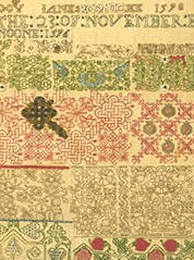 det. Bostocke samplar, V&A, London
The simplest definition of "blackwork" is monochrome embroidery on linen, but's it is more than that - there are many traditional monochrome-on-linen embroideries that are most certainly NOT blackwork. And so, rather than trying to define with rules, we define with STYLE - whether counted, scrollwork, or strapwork, in any color, "blackwork" has a look all its own.
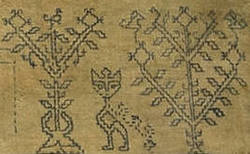 det. Coptic samplar, V&A, London
The roots of blackwork embroidery seem to be in the Middle East - some of the earliest recognizeable finds are pieces from 14th-15th century Coptic tombs (see the photo above). The technique journeyed into Europe - in the baggage of Crusaders or pilgrims? along the trade routes? - and made its way to every western country, but seemed to find its most welcoming home in the fertile soil of England...
Legend has it that Katherine of Aragon brought blackwork to England. It was most likely there well before, but surely fastination with the young Spanish princess added to the popularity of "Spanisshe Stitche", while at the same time a new fashion for showing more of one's body linen added impetus.
From the earliest painted evidence - around the 1470s in Spain is the earliest I've found so far - to the new fashion for polychrome embroideries and lace that appeared around the turn of the 17th century, blackwork's heyday lasted a little more than a hundred years. It's come round again, in the hands of history buffs and modern stitchers all creating - and re-creating- Beautiful Things.
Legend has it that Katherine of Aragon brought blackwork to England. It was most likely there well before, but surely fastination with the young Spanish princess added to the popularity of "Spanisshe Stitche", while at the same time a new fashion for showing more of one's body linen added impetus.
From the earliest painted evidence - around the 1470s in Spain is the earliest I've found so far - to the new fashion for polychrome embroideries and lace that appeared around the turn of the 17th century, blackwork's heyday lasted a little more than a hundred years. It's come round again, in the hands of history buffs and modern stitchers all creating - and re-creating- Beautiful Things.
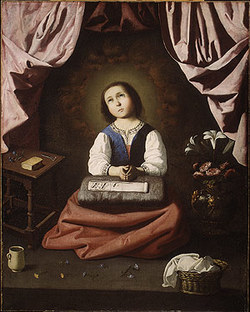 de Zurbaran, MMoA, NYC
Hi! My name is Liadain, and I am a blackwork geek. I design it, stitch it, research it, collect it, teach it (At least as well as I can from my hermitage here in The Wildernesse), and I am The Management of this site and its accompanying blog. The site is still growing, and I happily add every good link and reference I can find - please contact me with your favorites. I hope new blackworkers find the encouragement and information here they need to get started, and that experienced stitchers find a new twist for fresh inspiration.
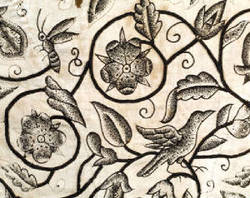 16-cent blackwork fragment, private collection
Why Practical Blackwork ? Because it IS, when you discard all the Victorian Ruuuules (see the introductory quote below) and look at it from an historic point of view. Blackwork can be - and often was, in "period" - as simple as Holbein and back stitches on linen, or as fabulously fancy as the coifs and nightcaps preserved today in museums, but either extreme had some things in common - mostly short, hard-wearing stitches, a visual impact that could help disguise dirt and stains in an age before "Spray and Wash", a simplicity of materials . Blackwork was the perfect amateur technique - a young lady wishing to make a gift for her beloved could adapt an image from one of the herbals, bestiaries, or other printed books then coming into widespread use, even if she'd never seen a pattern book, or copy the pattern from another embroidered article, and create something beautiful with little more than needle and thread.
Don't let the "YouGotta" folks scare you! Historic blackwork was counted or uncounted, reversible or sloppy-backsided, black or blue or green or red or purple... You don't need fancy equipment or expensive materials - you can use anything from the finest silk threads and heirloom lawn all the way up to burlap and knitting worsteds to create your own Beautiful Things. I hope you find the Perfect Thing somewhere in these pages!
Don't let the "YouGotta" folks scare you! Historic blackwork was counted or uncounted, reversible or sloppy-backsided, black or blue or green or red or purple... You don't need fancy equipment or expensive materials - you can use anything from the finest silk threads and heirloom lawn all the way up to burlap and knitting worsteds to create your own Beautiful Things. I hope you find the Perfect Thing somewhere in these pages!
Notice!!
This site is under construction by a complete technodufus, and with any luck and with the help of generous contributors (and under the influence of The Management's OCD) will ALWAYS be under construction! Any errors are probably the fault of The Management, and not of the Advisors thereof. For your own safety, please wear your hardhat at all times and keep all extremities inside the carriage. Look out for dangling participles, hanging chads, and tangled threads....
This site is under construction by a complete technodufus, and with any luck and with the help of generous contributors (and under the influence of The Management's OCD) will ALWAYS be under construction! Any errors are probably the fault of The Management, and not of the Advisors thereof. For your own safety, please wear your hardhat at all times and keep all extremities inside the carriage. Look out for dangling participles, hanging chads, and tangled threads....